DNA: The Molecular Instruction System
Living organisms depend on DNA to store and transmit genetic information. DNA is built from four nucleotides, represented by the letters A, T, C and G. The sequence of these nucleotides provides instructions used in processes such as RNA production and protein synthesis.
Genes occupy particular regions of DNA, but the genome also contains regulatory sequences that influence when and where genes are expressed. The biological effects of a genetic change therefore depend on more than the identity of the affected gene. They also depend on the location of the change and its influence on molecular function.
Some DNA variants have little detectable effect. Others modify protein sequences, change the amount of RNA produced, alter splicing or disrupt cellular regulation. For example, sickle cell disease is associated with a specific variant in the HBB gene that changes the amino acid sequence of beta-globin.
Understanding whether a genetic variant actually causes a biological effect is a central challenge in molecular genetics. Researchers may observe a variant in DNA, but its functional importance often remains uncertain. Genome editing offers a way to investigate this question through controlled genetic changes in experimental systems.
Why DNA Repair Makes Genome Editing Possible
DNA is chemically stable enough to preserve genetic information, but it is not immune to damage. Environmental factors, metabolic processes and errors during DNA replication can produce molecular lesions that cells must detect and repair.
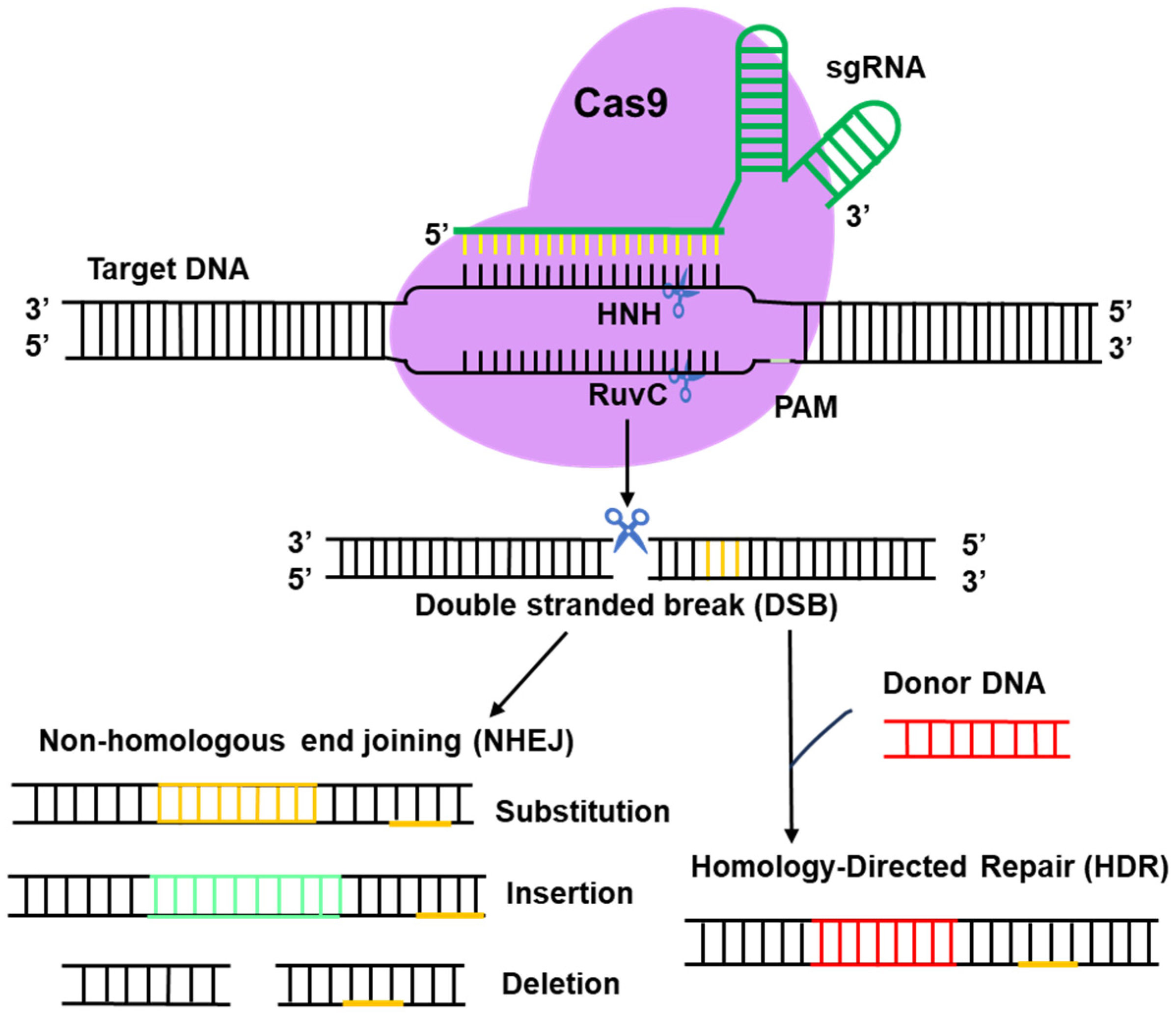
One particularly consequential type of damage is a double-strand break, where both strands of the DNA molecule are disrupted. Cells possess several repair pathways that respond to this type of damage. Two important examples are non-homologous end joining (NHEJ) and homology-directed repair (HDR).
NHEJ reconnects broken DNA ends. It can restore the original sequence, but end processing may also create small insertions or deletions, known as indels. HDR uses homologous DNA information as a template and can support a precisely specified change when an appropriate donor template is available.
These mechanisms are fundamental to conventional CRISPR-Cas9 editing. Cas9 creates a targeted break, while the cell's repair machinery largely determines the sequence outcome. Editing is therefore a collaboration between a programmable molecular tool and an endogenous biological process.
Key distinction: Targeting a DNA location and obtaining a particular final DNA sequence are two different challenges. Cas9 can direct a break to a chosen region, but cellular repair is not fully predictable.
How CRISPR-Cas9 Became a Genome Editing Tool
CRISPR systems originated as components of defense mechanisms found in bacteria and archaea. These systems can acquire sequence information from invading genetic elements and use RNA-guided proteins to recognize related sequences during subsequent encounters.
Scientists adapted this biological machinery into a programmable genome-editing system. In a widely used configuration, the CRISPR-associated protein Cas9 works with a single-guide RNA (sgRNA) that directs it toward a complementary DNA sequence.
The commonly used Cas9 enzyme from Streptococcus pyogenes recognizes a nearby protospacer-adjacent motif (PAM), typically NGG. The guide RNA specifies the neighboring target, while Cas9 recognizes the PAM and can cleave both DNA strands. Different Cas proteins and engineered variants recognize different PAMs.
The importance of this discovery is programmability. Instead of engineering an entirely new protein for each target sequence, scientists can alter the guide sequence to redirect the molecular system. This greatly broadened access to experimental genome engineering.
How Researchers Investigate Genes With CRISPR
Genome editing becomes scientifically valuable when an intentional genetic perturbation is connected to a measurable cellular outcome. Researchers might investigate whether a gene contributes to cell proliferation, a signaling pathway, a developmental process or the response to a compound.
In a knockout experiment, researchers seek to disrupt a gene's function. Conventional CRISPR approaches often exploit indels produced after DNA repair. A frameshift within a coding region can disrupt protein production, although not every edit eliminates gene function.
Other experiments aim to introduce a specific genetic variant to examine its biological consequences. Researchers can compare edited and appropriate control cells using molecular measurements, protein analysis, microscopy or functional assays.
CRISPR interference (CRISPRi) and CRISPR activation (CRISPRa) provide another approach. They use catalytically inactive Cas proteins, often linked to regulatory domains, to reduce or increase gene expression without necessarily changing the DNA sequence.
The central goal is not simply to create edited DNA. It is to test a biological hypothesis. The next question is whether the intended molecular modification actually occurred in the cells.
How Scientists Measure Editing Outcomes
Genome editing must be evaluated experimentally because a treated cell population may contain several different genomic outcomes. Some cells may retain the original sequence, others may carry the intended edit, and others may contain unintended sequence changes at the target locus.
DNA sequencing is one of the most important methods used to characterize these outcomes. Sanger sequencing is useful for relatively simple sequence analyses, while targeted next-generation sequencing can characterize mixtures of variants across many DNA molecules.
Researchers may also measure changes in RNA expression, protein abundance or cell behavior. For example, demonstrating a DNA modification does not establish that the corresponding protein is absent. Molecular and functional measurements can help evaluate whether the intended biological effect has occurred.
Appropriate controls are essential. These may include unedited cells, suitable experimental control treatments, independent biological replicates and complementary validation assays. The precise controls depend on the biological question and the editing method.
| Technique | What It Measures | Scientific Purpose |
|---|---|---|
| Sanger sequencing | DNA sequence in an amplified region | Reviewing targeted sequence changes |
| Targeted NGS | Frequencies of sequence variants | Quantifying complex editing outcomes |
| RT-qPCR | Selected RNA transcript levels | Assessing transcriptional effects |
| Protein assays | Abundance or activity of proteins | Evaluating downstream functional effects |
| Functional assays | Cellular or molecular phenotypes | Connecting an edit to biological function |
Combining these measurements can distinguish between a technically successful sequence modification and a biologically meaningful result.
From Sequencing Reads to Editing Results
Modern genome-editing experiments may generate thousands or millions of sequencing reads. These reads must be processed before scientists can determine which changes occurred and how frequently they appear.
In a typical targeted sequencing analysis, reads undergo quality assessment and are compared against an appropriate reference sequence. Computational tools identify substitutions, insertions and deletions within the analyzed region. The resulting counts can be summarized as variant frequencies.
Interpretation requires care. Sequencing errors, amplification bias and differences in sample composition can influence observed frequencies. The proportion of sequencing reads carrying a change is not necessarily identical to the proportion of cells with that change.
Researchers must also distinguish edits affecting different gene copies, especially in cell populations with unusual chromosome numbers. For some experiments, long-read sequencing, copy-number analysis or other molecular methods may be needed to investigate larger structural changes that targeted short-read assays could miss.
The final analytical output is not merely a percentage labeled "editing efficiency." It is a collection of molecular observations that must be connected to the intended edit, the experimental controls and the actual biological question.
Important distinction: Detecting the desired variant does not mean every edited cell contains only that variant. Researchers should also examine unintended outcomes and the structure of the edited locus.
Understanding Off-Target Effects and Unexpected Edits
CRISPR-Cas9 is programmable, but its targeting is not perfectly exclusive to a single genomic location. Guide RNAs can sometimes support binding and cleavage at other DNA sequences with sufficient similarity to the intended target. These events are called off-target effects.
Unintended outcomes can also occur at the intended target itself. In addition to small indels, certain experimental settings may produce larger deletions, rearrangements or changes affecting multiple gene copies. This is why on-target characterization and off-target assessment are complementary parts of genome-editing validation.
Computational methods can help identify genomic regions that resemble the guide sequence and may merit further investigation. Experimental assays can then test potential unintended editing events. No single method detects every possible outcome, so assay selection depends on the intended use and the relevant risks.
Such evaluations become especially important when moving from exploratory research toward therapeutic applications. Experimental success alone is insufficient to establish clinical safety, which requires additional preclinical, clinical and regulatory evidence.
Beyond Conventional Cas9: Base Editing and Prime Editing
Conventional nuclease-based CRISPR editing uses DNA cleavage and cellular repair to generate sequence changes. Newer genome-editing approaches have been developed to expand the range of modifications and reduce dependence on double-strand DNA breaks.
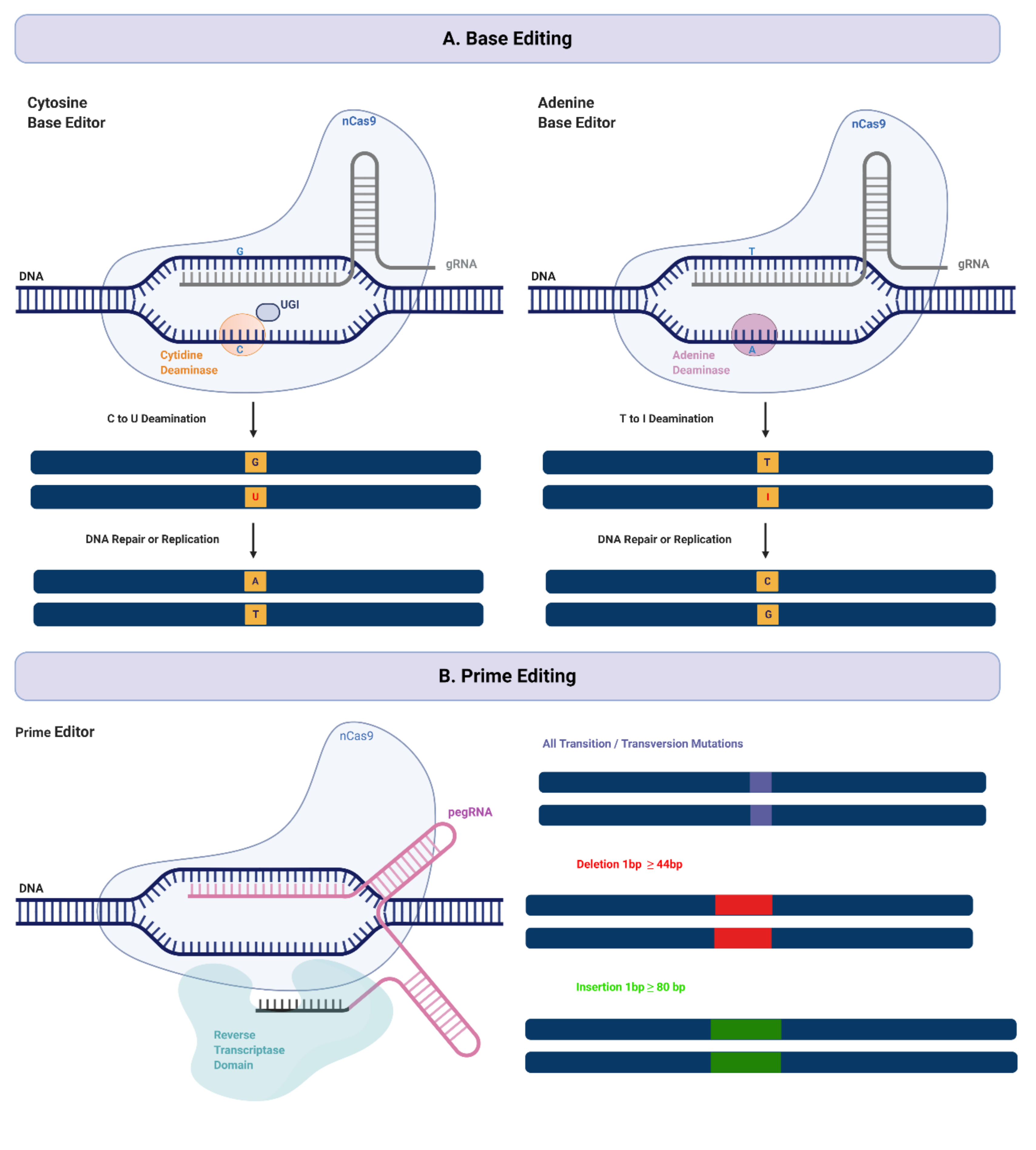
Base editors typically combine a DNA-targeting Cas protein with a nucleotide-modifying enzyme. Common cytosine base editors can produce C-to-T changes, while adenine base editors can produce A-to-G changes, considered at the edited DNA strand. Complementary strand changes follow accordingly. These tools do not require the same double-strand cleavage used in conventional Cas9 nuclease editing.
Prime editing uses a Cas9 nickase linked to reverse transcriptase, together with a prime-editing guide RNA (pegRNA). The pegRNA carries targeting information and an RNA template encoding the desired sequence modification. Prime editing can support a broader range of substitutions and certain insertions or deletions.
Neither approach eliminates every technical challenge. Editing efficiency, delivery, sequence context and unwanted changes remain important considerations. The most appropriate method depends on the genetic change being investigated.
| Editing Approach | Typical Capability | Important Limitation |
|---|---|---|
| Cas9 nuclease | Targeted double-strand breaks and repair-mediated changes | Repair outcomes can be heterogeneous |
| CRISPRi / CRISPRa | Reducing or increasing gene expression | Does not necessarily change DNA sequence |
| Base editing | Selected nucleotide substitutions without intentional double-strand breaks | Editing window and possible bystander edits |
| Prime editing | Multiple substitution types and certain insertions/deletions | Efficiency and outcomes vary by locus and cell type |
Connecting Genome Edits to Biological Meaning
Genome editing becomes especially powerful when combined with methods that measure the effects of changing a gene. Functional genomics investigates relationships between genetic information and biological function, using experiments that connect DNA with observable molecular and cellular characteristics.
CRISPR screening is one example. Researchers can study the effects of perturbing many genes across a population of cells. Changes in cellular survival, gene expression or other phenotypes can help identify genes associated with the process under study.
Integrating CRISPR perturbations with RNA sequencing provides a more detailed view of molecular responses. If modifying a transcriptional regulator changes the expression of numerous downstream genes, transcriptomic analysis can reveal the resulting expression pattern. These findings can then be compared with known pathways and reference datasets.
Bioinformatics resources such as Gene Ontology help organize the functions and biological processes associated with affected genes. Knowledge graphs can connect these genes to proteins, pathways, phenotypes and scientific evidence. This supports the generation and evaluation of new biological hypotheses.
However, identifying a statistical association between a genetic perturbation and a phenotype does not automatically establish a complete causal mechanism. Independent experiments and complementary measurements remain important. The value of these integrated methods lies in turning an isolated sequence change into a scientifically interpretable observation.
From Genome Editing to Modern Biotechnology
CRISPR-based technologies are now important tools in basic research, functional genomics, biotechnology and therapeutic development. Their impact comes from the ability to investigate a genetic hypothesis through a defined molecular perturbation and subsequent biological measurement.
In biomedical research, genome editing can help create cellular models of genetic disease, evaluate candidate molecular targets and investigate mechanisms associated with treatment response. In cancer biology, CRISPR screening can help identify genes that influence cellular survival or sensitivity to experimental compounds.
Genome editing is also relevant to therapeutic development. An established example is ex vivo editing of a patient's blood-forming stem cells to modify the regulation of fetal hemoglobin in certain hemoglobin disorders. Such clinical applications require regulated manufacturing, careful patient selection and long-term safety monitoring.
Agricultural biotechnology offers another area of investigation. Genome editing can be used to study genes associated with crop traits, plant development and environmental stress responses. In microbial biotechnology, genetic engineering can support research into metabolic pathways and biological production systems. Practical deployment depends on technical, ecological, regulatory and societal considerations.
The future of genome editing will not be determined by editing precision alone. Delivery technologies, genome-wide characterization, biological validation, transparent scientific reporting and responsible governance all influence whether an experimental approach becomes a reliable biotechnology.

CRISPR-Cas9 began as an adaptation of a microbial defense mechanism. Its scientific significance, however, extends well beyond DNA cleavage. It links the molecular foundations of heredity to programmable experiments, high-throughput sequencing, statistical analysis and the discovery of biological mechanisms.
The scientific connection: DNA stores the genetic information of a cell. DNA repair maintains genomic integrity and influences editing outcomes. CRISPR enables targeted perturbation of that information. Sequencing and functional assays reveal the molecular consequences. Bioinformatics, ontologies and scientific evidence help transform these observations into biological understanding. Modern biotechnology builds on this entire sequence of discovery.
Scientific References
1. Williams BO, Warman ML. Perspective: CRISPR/Cas9 Technologies. Journal of Bone and Mineral Research. 2017;32:883–888. View publication ↗
2. CRISPR-Based Genome Editing Through the Lens of DNA Repair. A peer-reviewed review of genome-editing mechanisms and cellular repair pathways. View publication ↗
3. CRISPR-Cas9 DNA Base-Editing and Prime-Editing. International Journal of Molecular Sciences. 2020;21(17):6240. View publication ↗
4. Strategies for Precise Gene Edits in Mammalian Cells. A review of repair-mediated editing, base editing and prime editing. View publication ↗
5. Advances in CRISPR/Cas9-Based Gene Editing in Filamentous Fungi. Journal of Fungi. 2025;11(5):350. View publication ↗
6. Ruden DM. Prime Editing for Precision Genetic Medicine: A Systematic Review of Technologies, Delivery, and Therapeutic Applications. Genes. 2026;17(9):1138. View publication ↗
The scientific figures are attributed to their original open-access publications. The article is intended for scientific education and does not provide clinical treatment instructions or a validated laboratory protocol.